Interest-free banking is a practical tool for building community wealth

JAK Members Bank
JAK Members Bank
JAK Members Bank

I am happy to report that the old saying “there is more than one way to skin a cat” applies to the banking industry as well. Here in the U.S. we’ve been taught to believe that the traditional way of banking is the only way and there are few if any alternative models. Originating in Denmark in 1931, the JAK Members Bank offers banking services on a fee basis, free of interest. JAK is an acronym for Jord, Arbete, Kapital which in Swedish means land, labor and capital, considered to be the primary means of production in classical economics. JAK banks are democratic, member owned, cooperative financial institutions.

The creation of this banking model was based on the belief that assessing interest is a primary factor in economic instability. There are four principles that the JAK operates from, which are:

  1. charging interest undermines a stable economy,
  2. interest is the cause of unemployment, inflation and the destruction of the environment,
  3. interest is a means of moving money from the poor to the rich and
  4. interest tends to favor projects which deliver high profits over a short period of time.

Because the JAKs perceive interest to be such a detrimental force, they operate outside of the capital market and would like to see it abolished completely. In other words they want to see a financial world in which interest is nonexistent. Much like any other bank or credit union the JAK accepts deposits and makes loans all without assessing or paying interest or dividend shares. Their depositors or members earn savings points at a rate of one point for every dollar saved. As a feature of ownership each member is allowed only one vote, regardless of the amount of their deposit or accumulated savings points. Members may borrow money based on the amount of savings points they have accumulated.

For example, if a member has deposits which total $1200.00 (the equivalent of 1200 savings points) they may borrow $1200.00 dollars, at a monthly repayment amount of $100.00 dollars for one year. That same member would be allowed to borrow an additional $600.00 dollars with no increase in their monthly payments, if they agree to save an additional $100.00 per month over the same 12-month period. At the end of the loan period $600.00 of the savings is given to the JAK to satisfy the additional monies borrowed and the balance of $600.00 belongs to the member to use as they please! Over the course of a year the loan is paid off and the member continues to save money. It’s a win/win proposition. Monthly payments are often higher in the JAK than for customers at a traditional bank, however, because JAK members aren’t charged interest on their loans they pay less money over time. This example is illustrative of how necessary saving is to the interest free banking system, in that it insures the liquidity of the bank and also it’s ability to offer loans to many members at any given time. The staff and JAK administrators are all volunteers that donate their time in the spirit of cooperation. They are also the primary recruiters of additional staff and bank members.

The JAK banking system is very appealing to me for many reasons. First and foremost it is a counterbalance to the existing interest-focused system that provides no benefit to the average individual, but favors big business and the majority of the traditional financial services industry. It is a viable alternative to the existing debt driven economy, which we are learning is not sustainable in that it demands never-ending growth and expansion. Last, but not least the JAK Members model is a co-op where members have come together to create and sustain a vehicle that benefits them and serves their needs. The bank is owned by it’s members that pay a membership fee and vote for a board of directors to represent them and their interests. Each member, regardless of the amount of their deposit or accumulated savings points is granted only one vote. I can’t think of a better model of cooperation and democratic control in the financial arena.

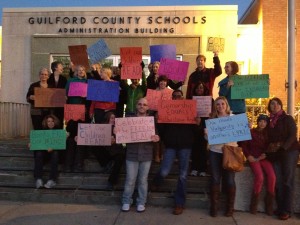
More books, not less! Guilford County parents organize to oppose book bans

Guilford County residents protest book banning in our schools.

About a week ago, some Guilford County residents carried a petition with some 2,200 names on it to the School Board, asking to eliminate controversial books from high school reading lists. They targeted certain books, like Margaret Atwood’s The Handmaid’s Tale and Isabelle Allende’s House of the Spirits, objecting to sexually explicit passages and what they saw as anti-Christian themes. Actually, using these books as examples, they asked for the school system to revise the entire way it selects books, so that books like these would not ever again appear on reading lists.

Well, community dialogue and activism is alive and well in Greensboro! In response to this threat of book banning, roughly 30 people marched from the Central Library to the School Board meeting on Eugene Street, carrying signs that read, “More books, not less!” and “Let Our Children Read!” Here’s a picture of some of that contingent when they arrived at the School Board building. Many marchers then entered the meeting, where they addressed the School Board, making sure that the Board knew there was large crew of folks who like the book selection policy just fine.

Book banning is NOT the way to deal with controversy and difference. More democratic dialogue, not less! Hooray!

Read more from the News & Record here.

The Short and Happy Life of the Fund for Democratic Communities

We're spending ourselves out of existence. (photo: 401(k) 2012)
We’re spending ourselves out of existence. (photo: 401(k) 2012)

Here’s something you may not have known about F4DC: we don’t plan on being around after 2020. No, we haven’t subscribed to any end-of-the-world doomsday scenarios. In fact, quite the opposite: we’re thinking that the chance of human survival past 2020, perhaps even into the next century, will be improved if we go out of existence!

At this point, you may be thinking, “Whoa! These folks have a curious view of their destructive potential, not to mention their own importance!”

Let me explain.

The vast majority of charitable foundations come into existence under an assumption that they’ll exist forever — “in perpetuity,” is the legal term of art. Under this model, foundations put their money resources — “financial principal” (never to be confused with “financial principles!”) — into investments that deliver interest or dividends or capital appreciation at a level that allows them to give away some money each year, while preserving or even growing the underlying principal.

By law, foundations have to give away or otherwise spend on charitable purposes 5% of their assets each year. Thus, if a foundation has $8 million in assets (about what F4DC’s assets are valued at these days), the US tax code requires it to put $400,000 each year toward charitable purposes.

Here’s the deal. The world is in a real pickle, and dribbling out $400,000 per year just isn’t going to have transformational impact. And we need some transformation!

The global financial crisis is just one of several deeply disruptive, linked crises that together portend a level of environmental, economic, and social collapse that is already radically altering how we live. Whether we want to change or not, big changes are coming — some of them are here already (Hurricanes Katrina and Sandy!) — due to the intersection of climate change, peak oil, and the non-sustainable nature of a global, corporate capitalism that has driven the world toward the greatest wealth inequality ever experienced by humanity. People are hurting, struggling to support their families and communities, as jobs disappear and wages stagnate. Catastrophic weather events escalate in number and severity, pushing communities past the breaking point. Our representative democracy is under siege from corporate interests who are unelected and unaccountable. And our grasp of direct democracy (that is, our community capacity to dialogue about our needs and decide on collective action to meet them) is shaky at best.

In the face of the failing economy, many people are recognizing the need to build a new economy to take its place: one where people and planet come before profits. Where the rewards of productivity go to the people who do the work. Where communities are enriched, not stripped, by businesses that are rooted in place. An economy built on the principles of cooperation, sustainability and solidarity, not competition and exploitation. At the same time, people around the globe and at home in the U.S. are coming together to demand that the voices of the 99% be heard, and in the process are relearning and inventing from scratch new democratic forms.

We’re at a pivotal moment, a time of opportunity on the one hand and real danger on the other. F4DC is striving to put its resources — both money and people power — in service to the massive project of building a just, sustainable and democratic economy in this critical period. It’s a big project, and it’s sure to last way past 2020. But we think F4DC’s greatest impact—our shot at transformational impact—is in these next eight years.

If you’re wondering where this “eight years” figure comes from: Ed and I actually came to this idea of spending down our resources a couple of years ago. At that time, we gave ourselves a ten-year horizon line. Seemed like that was enough time to hatch and work on some serious projects, but also a short enough time frame to concentrate the mind. We’re two years in now, and believe me, the 2020 deadline does indeed concentrate the mind. Our entire staff is struggling to define what it would look like for us to leave a lasting legacy and evaluating whether our program and grant-making activities are on track to achieve it.

Stay tuned: we’ll have more to say about the legacy we hope to leave in later blog posts. For now, just know we’re working with growing numbers of people in our city, North Carolina, and the Southeast (link to the Federation of Southern Coops and SGEP) in ways that we hope position us all to be around a whole lot longer, even if F4DC is no more.

We picture a web of strong people, versed in democratic arts, who are able to work together to rebuild their communities. We see organizations, institutions, and networks across the Southeast that link and nurture democratically-minded economic and political projects that flow from communities that are usually pushed to the margins: Black folks, poor whites, Native Americans, women, immigrants, young people. Imagine a growing pool of autonomous people and organizations who understand that their well-being is tied to the well-being of all, and have a pretty clear idea of how to build a new economy anchored in vibrant democratic communities. We think of F4DC and its resources as part of the “seed capital” for this new venture.